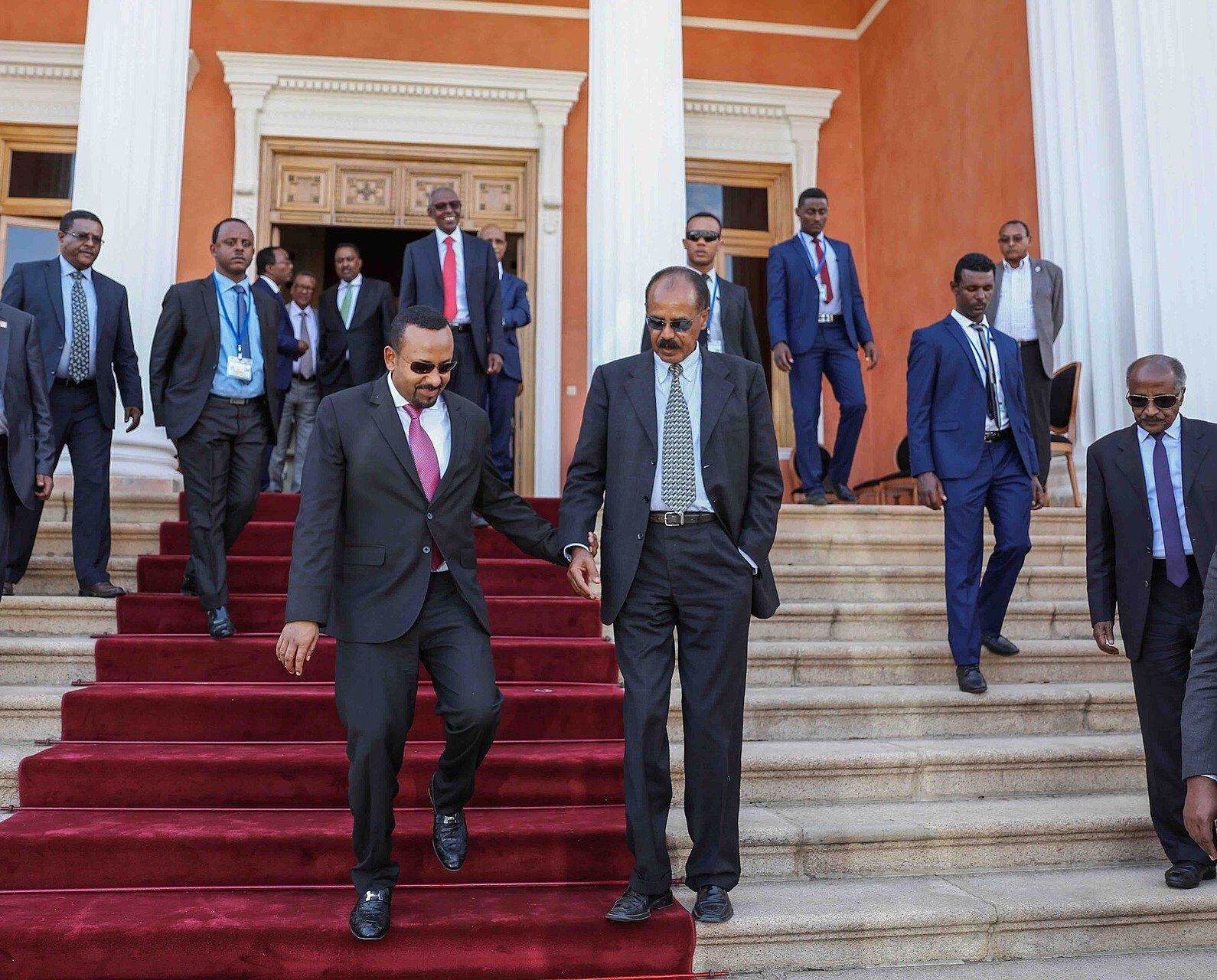
Ethiopia closed its embassy in Asmara on October 1 and ordered ten Eritrean diplomats to leave, and Eritrea cut all ties in return. In a letter made public on October 9, Ethiopia’s foreign minister accused Eritrea of an “all-out invasion” that reached up to 60 kilometres into Tigray, in northern Ethiopia, Reuters reports. Eritrea calls the accusation a pretext, and says Ethiopia wants to seize its port of Assab. Neither side’s account has been independently verified. The last time these two countries fought, from 1998 to 2000, the war cost 100,000 lives by Jimmy Carter’s count.
I have watched a crossroads like this before. When that war began in 1998, I was President of the Addis Ababa University Students’ Union. At first, like many civic groups, we called for peace and restraint. After Eritrean forces crossed into territory that Ethiopia then administered, our executive committee debated the crisis and decided that Ethiopia’s territory had been violated, and we mobilised thousands of students to protest. I remember how quickly calls for restraint gave way to mobilisation, and the human cost of the war that followed.
So I do not write as a neutral observer, and I will say where I stand. Ethiopia’s grievance over Assab is real, and Ethiopians are right to ask who decided that Ethiopia would lose the port. But I doubt that a war would give Ethiopia a port it could keep. And Eritrea would be wise to turn Assab into a deal while it still holds the port and can set the terms.
The facts on the ground are still unclear. On October 13, Reuters reported that Ethiopian government forces had reached Zalambessa, a border town. The US research group Critical Threats, citing the conflict-monitoring group ACLED, reports that federal forces withdrew from several border areas, Zalambessa among them, on October 17, and ACLED said on October 22 that neither federal forces nor the government-allied Tigray Peace Force are now in Rama, another border town. The Field has not seen the underlying ACLED entry for Zalambessa.
On October 14 Eritrea told UN Security Council members that Ethiopia has sought sea access “through negotiations if possible and force if necessary”. That is Eritrea’s description. The next day, in a state-broadcaster interview, Prime Minister Abiy Ahmed warned Eritrea of severe consequences without saying what they would be.
The two countries share centuries of history, families and trade, and deep wounds. In the 2020–2022 war in Tigray, Eritrean troops, whom Abiy acknowledged in March 2021 had entered Tigray, fought alongside Ethiopia’s army against the Tigray People’s Liberation Front (TPLF), the party that ran Tigray. A UN Special Rapporteur’s June 2021 report said Somali recruits trained in Eritrea had been moved to the front line, which would put all three governments in one camp. Mogadishu denied that its soldiers fought in Tigray, and Ethiopia said it had not asked for them. Ethiopia and Eritrea have since split.
Good leaders test their assumptions and prepare for several possible futures instead of betting on one, as I argue in my book Strategic Edge. I put my own position, and both governments’, through the same tests.
Two Positions, One Port
Ethiopia has a large population and a large domestic market, a strong army, regional influence and long-term economic potential. It is also landlocked. Ethiopia’s transport ministry says 96.7 percent of its foreign freight went through Djibouti in the year to July 2026, which costs money and leaves its economy exposed to decisions made outside its borders. In September, seven armed groups, among them the TPLF and the Amhara Fano movement, formed an alliance that says it will remove Abiy’s government by force. Addis Ababa accuses Eritrea of backing it, and Eritrea denies this. The Field’s editor, Ismail Abukar, set out the alliance and the accusation in African Arguments. Even so, war would disrupt trade, drain money from development and invite outside powers in, and Abiy has said sea access should be pursued peacefully.
But describing Ethiopia’s case as the needs of a landlocked country misses something. I believe the way Ethiopia lost Assab when Eritrea separated in 1993 was a historic failure of Ethiopian leadership. That is my own assessment, based on what I saw of the political climate at the time and on the absence of a transparent, inclusive constitutional process the public could follow. Such a decision, affecting millions of people, should not have been taken through what many Ethiopians regard as a closed, win-lose process. Abiy has made a similar complaint. On October 28, 2025, he told parliament that no official record exists of how Ethiopia lost its coast, and asked who made the decision. Jimmy Carter’s own account is plainer: he wrote that Meles Zenawi granted Eritrea independence in 1993 despite Carter’s concerns about Eritrea’s leadership, which left Ethiopia landlocked.
I also heard, several years after the events, from a former high-level official who was close to the inner circle at the time, that American negotiators urged Meles to put Assab on the table and that he declined, believing Ethiopia could buy port services elsewhere later. I cannot confirm this and I do not present it as fact. I am passing on what I was told. But the question behind the story is legitimate: who decided that Ethiopia would lose Assab, on what authority, and after weighing which alternatives? Records, testimony and careful historical and constitutional research should answer it.
My criticism does not settle the port’s legal status today. Eritrea’s independence and recognition created international realities that any responsible Ethiopian plan must face. But recognition does not take away Ethiopians’ right to question their own leaders, or to argue that a national interest was mishandled. Ethiopia also has to separate the justice of its grievance from the success of its response. Suppose it captured Assab by force. Could it keep the port, the roads to it, the shipping services and the investors safe at a cost it could bear? Military control is not the same as dependable access, and a negotiated agreement without credible guarantees is not dependable either. The test is not what Ethiopia can take, but what it can keep. So Ethiopia should commission a serious, independent review of the history, and in parallel compare the full cost of confrontation with negotiated access to Assab and other ports.
Eritrea holds a long Red Sea coast and the ports of Assab and Massawa, which give it commercial and political leverage. But a small home market, a narrow economy and years of isolation limit what it gets from those assets. Abiy described Assab as a “ghost town” in his October 19 interview. That is his claim, and I could not check it. But if the port is as empty as he says, that is the strongest argument for a deal that would fill it.
Eritrea’s leaders may believe that recognition and military readiness protect their position indefinitely. That would be dangerous. I am not predicting that Ethiopia will take Assab, and I am not calling for another war. I am asking Eritrean decision-makers to consider what planners cannot ignore: the balance of military power, regional alliances, diplomatic support and domestic politics can all change, and a settlement possible today may be much harder after another crisis.
Diplomatic support has already moved once this autumn: on September 18 the US Treasury removed the Eritrean Defense Forces and the ruling party from its sanctions list, and the State Department said the move was to advance US regional interests. The fighting escalated days later, and The Field’s piece on the war’s six overlooked angles found nothing that links the two. The question for Eritrea should not be only how to deny Ethiopia’s claim, but how to turn Assab into lasting prosperity and security while it can still negotiate from control. A well-built agreement could bring in revenue, jobs and investment without Eritrea accepting what it sees as a surrender of sovereignty. Eritrea’s security concerns are real, and any deal must meet them. But refusing indefinitely to discuss Ethiopia’s grievance or its practical needs could deepen resentment and hand the dispute to the next generation on worse terms.
The strongest objection is one Asmara’s own statements point to: that talks about Assab under this pressure would be talks at gunpoint, and that a deal on access would be the first step toward losing control of the port. That fear is not imaginary. Crisis Group says Asmara has viewed Abiy’s sea-access rhetoric as a threat to seize Eritrea’s coastline, especially Assab, by armed force. In March 2025 Abiy ruled out a war with Eritrea over Red Sea access. It is why a simple promise to reopen Assab will not be enough. Ethiopia fears that depending on another government’s decisions is itself a danger. Eritrea fears that a larger neighbour will turn access into a demand for control. Both are right to worry. Any deal would need enforceable commercial terms, guaranteed transit rights, investment, credible security safeguards and an independent way to settle disputes, and a separate forum to examine Assab’s history, so that disagreement about the past does not block every practical step.
Four Futures
Two uncertainties matter most here: whether the governments choose confrontation or talks, and whether the wider region pushes toward stability or competition.
In the first future, contained rivalry, the governments stay hostile but avoid a major war. Ethiopia stays dissatisfied with its sea access, and Eritrea pays for permanent vigilance. One miscalculation could end it.
In the second, strategic peace, the governments agree a lasting arrangement for Assab, with clear access rights, fair commercial terms, investment and security guarantees, and the history goes to its own credible forum. Neither side gets everything, but both gain what they could not get by confrontation. It is the best outcome, not the most likely.
In the third, regional crisis, confrontation grows into war, perhaps drawing in armed groups or outside powers. Ethiopia might win battles and still inherit an unsafe port and huge costs. Eritrea might hold its ground and still suffer heavy human and economic losses. The lesson is that a tactical victory can become a strategic defeat.
In the fourth, a fragile thaw, the governments tone down their language, restore contact and try limited steps, such as trade, without settling the main dispute. Setbacks are likely, but the risk of accidental escalation falls, and modest cooperation can lead to a larger deal.
A month ago, contained rivalry would have been the safe bet. With the embassies closed, the accusations before the Security Council and the fighting near the border, regional crisis is no longer a distant risk. The leaders of Egypt, Eritrea, Sudan and Somalia have already declared that Red Sea control should stay with coastal states, which Al Jazeera says appears aimed at Ethiopia, and The Field’s analysis of that declaration found no penalty in its text.
Getting from here to a strategic peace would mean three separate but coordinated efforts: calming the situation now, reviewing the historical record, and negotiating the commercial terms. A group of historians and legal experts acceptable to both sides could examine the contested record without deciding the result in advance. The aim is an arrangement that survives changes of government and delivers measurable results.
I do not believe the answer to a historic wrong, real or perceived, has to be another devastating war. Ethiopia should use its strength to widen its options, not narrow them to one costly confrontation. And I would urge Eritrea’s leaders not to mistake today’s position for a permanent guarantee. The best time to negotiate may be when a government still has the most freedom to set the terms.
What I do not know is substantial. I do not know whether Eritrean troops are still on Ethiopian soil, how many people have died, or what Ethiopia intends for Assab. I do not know what the decision-makers of 1993 weighed, and the account of the American negotiators rests on one person’s word to me, not on a document.
I remember 1998. The real victory is not to win the argument over Assab. It is to build a future in which Ethiopia’s legitimate aspirations and Eritrea’s lasting security can both be met, without condemning another generation to war.
What to watch. Activity along the border, the war in northern Ethiopia, outside military support, official language, and whether anyone reopens a line of communication between Addis Ababa and Asmara.
Comments
Every comment is read by a person before it appears, so yours will not show straight away. We publish comments that are civil and on the subject. To report a mistake in the piece, use the corrections page, so it is fixed in the piece itself.