
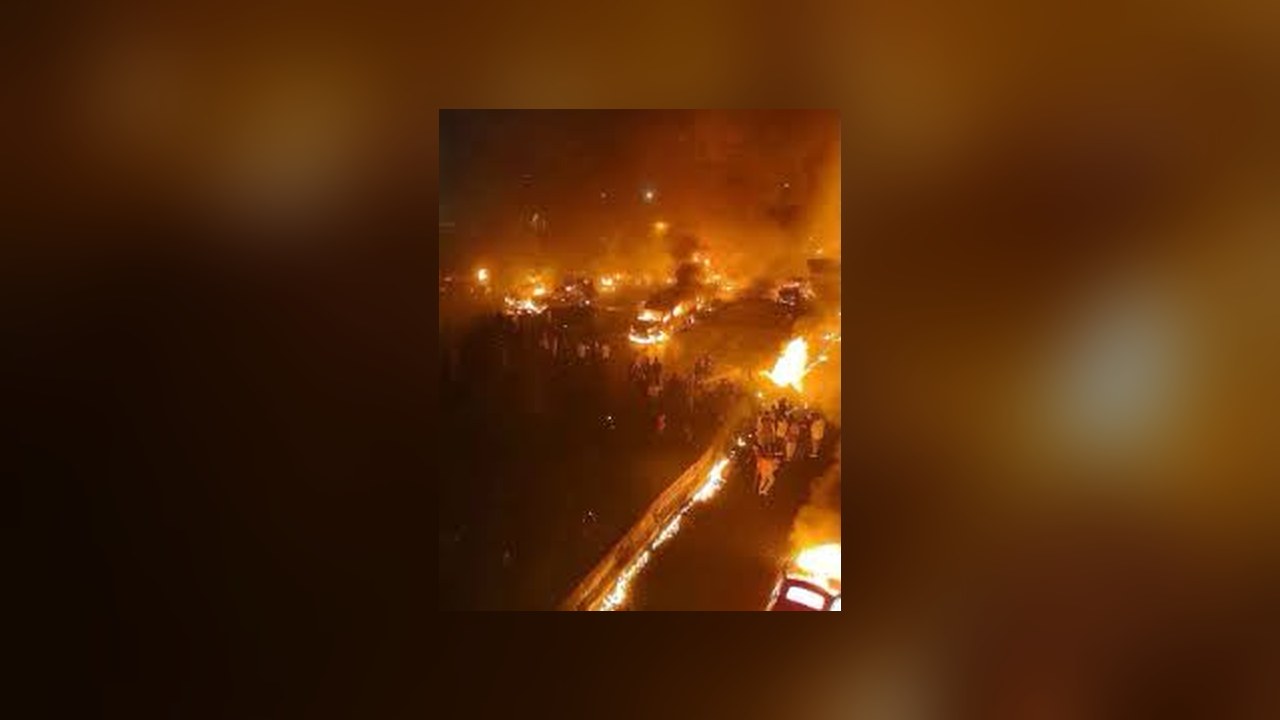
On Wednesday evening, 25 November, in the middle of rush hour, a fuel tanker overturned on the Ring Road in al-Waraq, on the Giza side of Cairo. Spilled petrol caught fire and the fire spread through the traffic around it. Egypt’s Health Ministry put the final toll at 31 dead and 26 injured, and prosecutors said 27 vehicles had burned. A man stuck in the traffic behind it, Ahmed Sameer, told the Associated Press he saw at least eight bodies carried out of charred vehicles.
By Thursday prosecutors had a suspect, and he was not the tanker’s driver. They said they had detained a 21-year-old who was driving a car with his father beside him. According to his statement to investigators, he was doing 110 kilometres an hour and weaving between lanes to overtake. The front left of his car hit the back right of the tanker. He lost control, a tyre on the tanker burst, and the tanker hit a concrete barrier, overturned and spilled its petrol. Prosecutors sent him for a drug test and say they are still working out whether he is criminally responsible. He is a suspect, not a convicted man, and I found no result of the test.
That is a clear story with a person to blame, and it is the one most readers will keep. I think it leaves out the part that decides how many people died. A car hitting the back of a truck does not kill 31 people. A truck full of petrol in evening traffic does. The question that follows is why a loaded fuel tanker was on that road at that hour. As far as I can establish, the answer may be that the state decided in 2018 that it could be, although that rests on a single report.
Where the accounts differ
The prosecutors’ account is the suspect’s own, and it is not the only one. The Interior Ministry says it has video of the crash. As Egypt Telegraph reported the ministry’s description, a car tried to pass the tanker on its right and struck its right rear. The ministry then has the car veering the other way, hitting a microbus, going over a barrier and catching fire itself. It does not mention a burst tyre. I have not seen the video and cannot say which version is right. The prosecution will have to settle between them, and the order of events decides whether the fire started with the tanker or the car.
Some other explanations were ruled out quickly. Initial reports blamed a fallen high-voltage cable. The Transport Ministry denied the statement attributed to it, and the Electricity Ministry said its lines were taut before the fire and switched off automatically only after it began.
The tanker’s driver is the missing voice. Al Arabiya reported that he died in the crash. He was Hussein Ibrahim, 45, from Birkat al-Sab’ in Menoufia, and his body was found next to the burning truck. The Egyptian news site Zawia3 gives his full name as Hussein Ibrahim Mohamed Abdullah. According to Al Arabiya’s sources, the truck was a 2020 Mercedes Actros belonging to a contractor, loaded with about 51,000 litres of 92-octane petrol, and it left a depot east of Cairo at 5:20 pm. Zawia3 adds, citing early inquiries, that the truck’s tracking device showed 66 kilometres an hour. It also reports that an early security inspection pointed to the tanker driver losing control of the wheel, which is not what the prosecutors’ later statement says, and that the Interior Ministry’s first announcement on Wednesday evening spoke of gas cylinders, not petrol. These are early accounts from unnamed sources, and the prosecution has not confirmed them. If they hold, the tanker was moving at a modest speed with 51,000 litres of petrol aboard when a car at 110 hit it from behind. That fits the suspect’s account. It does not make the cargo less central.
The rule, and what it left out
Egypt does have a rule for this road. In September 2018, as the new Regional Ring Road opened, the government banned heavy trucks from the Cairo Ring Road from six in the morning until midnight, starting on 15 September. Zawia3 cites it as Prime Minister’s Decree 1721 of 2018, with a weight limit of five tonnes and fines of 1,000 to 3,000 pounds. Egyptian reports of the rollout give the weight limit as four tonnes. The purpose was to move heavy trucks off the capital’s main loop.
What the ban left out is the point. On the day it took effect, Youm7’s report on the traffic department’s rollout said that the decision allowed only petroleum-product and food-supply vehicles to keep using the Ring Road in Greater Cairo. Not every account of the ban mentions it. Masrawy’s report that day and a pre-launch explainer from Soutalomma list no exemption, and Daily News Egypt’s report of the plan made none either. I could not read the decree itself, so the exemption rests on Youm7’s report and on Al Jazeera’s note that prosecutors have not said why the tanker was there. No official has said the tanker broke the ban.
If Youm7 was right, the tanker was not defying the rule. It was inside it. That was a choice, and it has a logic. A city of this size needs its petrol stations and markets supplied every day. But the choice has a cost, and the exemption, as reported, mentions no hour or route limit. The ban was meant to take heavy vehicles off the Ring Road, and it let one of the most dangerous cargoes stay through the evening rush hour. I found no public sign that anyone weighed that at the time.
The government’s answer, and its gap
The Cabinet has answered the call for a rush-hour ban. Spokesman Mohamed Adel said on the DMC channel on Thursday evening that it is not practical. He said Egypt has more than 3,000 tankers, which made about 1.46 million trips last year, roughly 4,000 a day. He added that its 3,900 fuel stations need deliveries around the clock, and that confining the work to a short window is, in his words, close to a technical impossibility.
The arithmetic holds: 1.46 million trips over 365 days is 4,000 a day. But it answers a different question from the one asked. Confining every tanker in Egypt to the hours between midnight and six would be impossible. Nobody I found is asking for that. The transport workers’ union asked for tankers’ departure times to be regulated to limit their movement in rush hours, for escorts for high-risk loads, for designated and published routes that avoid dense areas, for tracking of speed and route, and for inspections of tanks, brakes and tyres. A member of parliament has asked for fuel vehicles to be banned at rush hour. The question is narrower: how many of those 4,000 daily trips use the Ring Road in Greater Cairo between about four and eight in the evening, and could those trips move to another hour or another road? The Cabinet has not said. A government that can count 1.46 million trips last year can count those.
Two other points make the answer thinner. Zawia3 reports that the spokesman also said the government will wait for the prosecution’s findings before approving changes to the rules for moving petroleum. But the prosecution is deciding whether one driver is criminally responsible. Its findings cannot say whether a loaded tanker should have been on the Ring Road at the evening rush hour, because that is a rule, not a crime. And two residents told Zawia3 that fuel trucks pass there often, including at rush hour. The rules the same outlet quotes for hazardous cargo, from the 2019 land-transport law and its 2021 regulations, require tankers to follow the routes and times written in their licences and to keep away from dense housing where no route is set. So the questions are specific. What route and times did this tanker’s licence allow, who sent it into the Ring Road at 5:20 pm, and why does a road that cuts through crowded housing carry fuel in the evening rush hour at all?
Speed, and the pattern
This road has seen this before. On 8 August 2020, Youm7 reported, a petroleum tanker overturned on the Ring Road in Maadi, its fire spread to seven cars, five people were injured and the tanker’s driver was arrested. Nobody died then, as far as that report says, and I found no sign that the rules for fuel on the Ring Road changed afterwards.
The other half of the story is the speed. If the suspect’s statement is true, a car was weaving through the Ring Road’s evening traffic at 110 kilometres an hour. Whether that is possible on that road at that hour, and whether anything watches the road for it, are questions for the Interior Ministry. The state statistics agency counted 5,829 road deaths in 2025, 10.8 percent more than in 2024. The failure is not confined to one road.
After the last big crash on the neighbouring road, the response fitted its cause. The Regional Ring Road is the road the 2018 ban sent heavy trucks to, and Al-Masry Al-Youm reported in July 2025 that it had seen 304 accidents in three years, with 239 deaths. After a truck crashed head-on into a microbus there in June 2025, killing 19, President Sisi ordered hazardous sections closed, repairs sped up and random drug tests for drivers. The truck driver was later convicted of manslaughter and sentenced to 15 years after tests found drugs in his blood. The risk after Wednesday is that the same logic points at one driver and one drug test, and leaves a fuel tanker on a crowded road in the hour when it does the most harm.
What I do not know
I do not know what caused the fire to start, because the Interior Ministry’s account and the suspect’s differ and the video is not public. I do not know the result of the drug test. I do not know the tanker contractor’s name, what route and times its licence allowed, or when it joined the Ring Road. I also cannot say whether the reports of its speed and cargo, which rest on unnamed sources, are right. I have not read the 2018 decision itself, and I cannot say whether the exemption it contains carries any hour or route limit. I put these questions to the Interior and Petroleum ministries on Thursday, through the public addresses on their own websites, and had no reply when I published. I could not find a working public contact for the Transport Ministry, so it has not been asked. Any answers will be added, and the piece will say plainly if the ministries do not reply.
Three things will show whether the state is asking the right questions. The first is whether the prosecution’s findings say when the tanker entered the Ring Road, from where and under what permission. The second is whether the government publishes the exemption’s wording and says whether it carries any hour or route limit. The third is whether the Cabinet publishes how many tanker trips use the Ring Road at the evening rush hour, and whether a narrow rush-hour rule follows. If none of them do, the answer to why a fuel tanker was on that road in the evening rush hour is, on the reporting I found, the one the 2018 decision already gave.
Comments
Every comment is read by a person before it appears, so yours will not show straight away. We publish comments that are civil and on the subject. To report a mistake in the piece, use the corrections page, so it is fixed in the piece itself.