
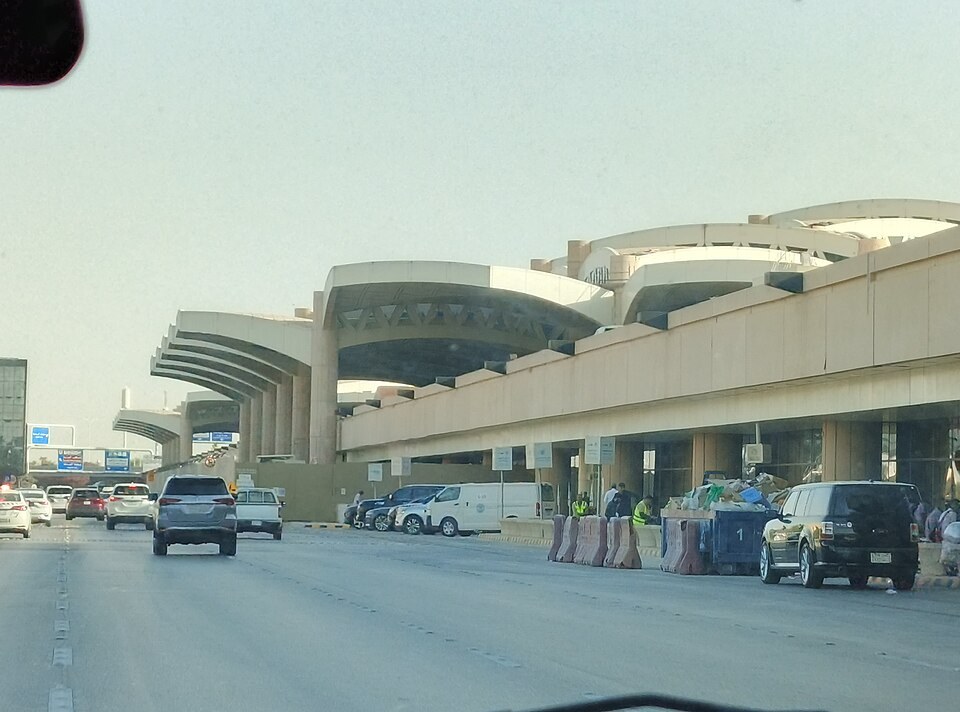
On Saturday afternoon, October 10, an injured traveller told Reuters he saw something fly across the sky outside King Khalid International Airport in Riyadh. Then part of the ceiling near a departure gate collapsed. An eyewitness saw an explosion and then several people lying hurt on the ground inside. More than a dozen ambulances raced to the terminal. Saudi Arabia’s threat-warning system had sent no alert, Reuters reported. The civil aviation authority counted 12 dead, among them four Saudis, two Bangladeshis and one each from the United States, Jordan, Palestine, Syria, Sudan and Egypt, and 309 wounded, AFP reported. An injured Indian citizen died the next day, The National reported, making 13. A 32-year-old resident, describing the aftermath to AFP, said: “People were running while carrying injured people, covered in blood.”
Fifteen days later, on Sunday, October 25, the airport reopened to limited traffic. Hours earlier, AFP journalists in Riyadh had heard three explosions, and the Saudi-led coalition said it had shot down a ballistic missile and two drones aimed at the capital, AFP reported. The Houthi military spokesman called the airport unsafe and a military target, and warned airlines, staff and travellers away from it.
Asked whether the United States would join Saudi Arabia’s war on the Houthis, the Yemeni armed group that says it fired the missile, President Donald Trump told reporters on October 10: “We may. We’re going to look at it.” On October 13 he wrote on Truth Social that the Houthis are “behaving very badly” and probably acting at Iran’s urging, and added, “I’ll be there after the Elections, and I will never forget!”, Al Jazeera reported. The US midterm elections are on November 3.
Washington is about to answer the wrong question. The one in the news is whether to bomb Yemen. The one that decides what happens next is how a weapon that is cheap to repeat keeps reaching the front door of a country the world’s oil market leans on. The answer is arithmetic. Saudi Arabia and its partners fire interceptors that cost millions at drones that cost tens of thousands, and neither courage nor bombing changes that sum.
The sum
King Khalid International Airport handled more than 37 million passengers and 269,000 flights to 113 destinations in 2024, the Saudi Press Agency reported. It is the gate to a country staking its future on being open, with Expo 2030 and the 2034 World Cup to host. Britain, France and Germany told their citizens to avoid Riyadh, the New Arab reports. My reading: the Houthis have found a cheap way to press on that plan. The Saudi-led coalition said on October 15 that the Houthis hit the airport 20 times between October 1 and 11, with 17 dead and 333 wounded, the Associated Press reported; those are its own unverified figures. Al Jazeera calls the October 10 attack the deadliest on the kingdom in more than a decade.
Two regional officials told the Associated Press, unnamed, that an early inquiry found the Houthis sent drones first to clear a path for cruise missiles (small jet-powered weapons that fly low) and ballistic missiles (fired high into the air, falling onto the target) that flew more than 1,000 km, and that there was no early warning. I cannot check what anonymous officials say. What I can check is the price tag. A Patriot interceptor, the missile that shoots other missiles down, costs about $4 million, while the drones it is used against cost at most tens of thousands of euros, Bruegel’s analysts write. A THAAD interceptor, the longer-range US system, costs $12 million to $15 million, and Patriots take more than two years to build, with about 600 made a year, the Observer Research Foundation’s Samriddhi Vij reports. I found no reliable prices for the Houthis’ own weapons, so these are for Iranian-designed drones. Analysts told Al Jazeera that Saudi defences were built mainly with Iran in mind. Newsweek’s summary of a Reuters report says Saudi officials themselves say the kingdom is running low on interceptors. A defender that pays many times more per shot, from a stock that takes years to refill, will lose a long contest even if every crew does its job.
Cheaper layers exist, and Vij sets them out. Ukrainian-designed interceptor drones cost $800 to $3,000 and, Ukrainian operators say, hit 97 percent of incoming Iranian-type drones. Lasers cost a few dollars a shot but weaken in dust and haze. Neither stops ballistic missiles. France is already sending soldiers, radars and defences to Yanbu, Gulf News reports. Whether the sum has changed will show in a plain measure: 30 days with no Saudi civilian airport hit and Riyadh open. The reopening does not show it yet. The AP said limited domestic traffic resumed on October 21, with only Saudia and flynas flying, and AFP and The National describe a wider reopening on October 25, of Terminal 1 for domestic flights and Terminal 2 for international flights by Saudi airlines, still limited. Late on October 21 an attack on King Fahd airport in Dammam killed one person and wounded eight, and no group had claimed it when the AP reported. On October 24 the Houthis claimed strikes on Saudi airports, the East-West pipeline pumping stations, an Aramco facility in Yanbu and the Rabigh refinery. Saudi Arabia did not confirm any of it, Malay Mail reported, citing AFP. On October 26 the coalition said it had destroyed two ballistic-missile launchers in Sanaa, one of which had fired at Riyadh, The National reported.
No rules for airports
What is missing is any agreement that civilian airports are off limits. A UN-brokered truce held from April 2022, and a UN roadmap followed in December 2023. Annelle Sheline of the Arab Center Washington DC dates its end to July 13, 2026, when the runway at Sanaa airport was bombed as a plane carrying a Houthi delegation from Iran tried to land. Yemen’s government says it did it and the Houthis blame Saudi Arabia, and I found no neutral account that settles it. A week later the Houthis announced a blockade of Saudi oil exports through the Bab al-Mandab, the narrow strait at the bottom of the Red Sea. In early October Yemen’s government announced an offensive to retake Sanaa, and the first airport strike followed the next day. The Houthis call the airport attacks payback for Saudi strikes on civilian sites in Yemen, which I could not verify. The UN envoy, Hans Grundberg, called them a grave escalation.
The rules of war forbid deliberate attacks on civilians and civilian sites, and bind Saudi Arabia in Yemen as much as the Houthis in Riyadh. With nobody checking, each side can say the other struck first, and the dead are counted only by the combatants. A truce that covered civilian airports on both sides, with UN monitors checking each claim, would be a small step back toward the December 2023 roadmap. It would also give the world a count of the dead that does not come from the people doing the killing. I found nothing in the reporting that shows such a truce, or monitors to check one, is on the table.
The oil
The same sum threatens the oil. The war with Iran began on February 28, and Brent was about $72 before it and peaked near $119, according to Al Jazeera, although Trading Economics lists a four-year high of $114.44 on May 4 and I could not settle the difference. Brent was near $113 a barrel on October 22, according to Trading Economics, my only source for that figure, and I could not confirm a later price. Much Saudi oil used to leave through the Strait of Hormuz, the narrow sea passage at the mouth of the Gulf, which has been disrupted since March. So the kingdom leans on an East-West pipeline to the Red Sea port of Yanbu, which Reuters data cited by Al Jazeera says recently carried 4 to 5 million barrels a day, about 4 to 5 percent of the world’s supply. Drones hit it on September 11; Iraq’s prime minister’s office says they were launched from Iraq, and no group has claimed it. Oilprice.com reports Houthi claims of strikes on Yanbu on September 18 to 19, which Saudi Arabia says hit only civilian infrastructure, with no damage reported. The International Energy Agency’s board agreed on October 15 to speed up releases of emergency stocks, Reuters reported, but I found nothing on a plan for a strike on Yanbu. The market has so far treated the airport strikes as a warning, not a loss of supply. The world’s exposure is not the airport but the single bypass to Yanbu.
Could it have gone differently?
Two choices look different with hindsight. The first is the defence, which analysts say was built mainly with Iran in mind, not a cheap, repeated threat. The second is Washington’s answer in 2025, which was force. The New York Times reported in September, as the Boston Globe carried it, that after a call from Crown Prince Mohammed bin Salman Trump told the Pentagon to prepare airstrikes, then pulled back as bombs were being loaded; that rests on anonymous officials. The same report says that in spring 2025 the US bombed the Houthis for more than 50 days and struck over 1,000 targets, at a cost of about $1 billion in munitions in the first month, before a ceasefire, and that the Houthis have since rebuilt much of their strength. That is the trouble with force as an answer to a cost problem: launchers and drones are cheap to replace, so bombing them does not change the sum, and an open-ended campaign has no point at which it can be called finished. Trump’s only date so far is “after the Elections.” A Houthi official has warned of a “swift and painful response” if the US joins in. The US State Department ordered non-emergency government employees and their families to leave Saudi Arabia, citing the Houthis’ “increasingly engaged” hostilities, Al Jazeera reported. I have found no US decision to join the war.
Comments
Every comment is read by a person before it appears, so yours will not show straight away. We publish comments that are civil and on the subject. To report a mistake in the piece, use the corrections page, so it is fixed in the piece itself.