
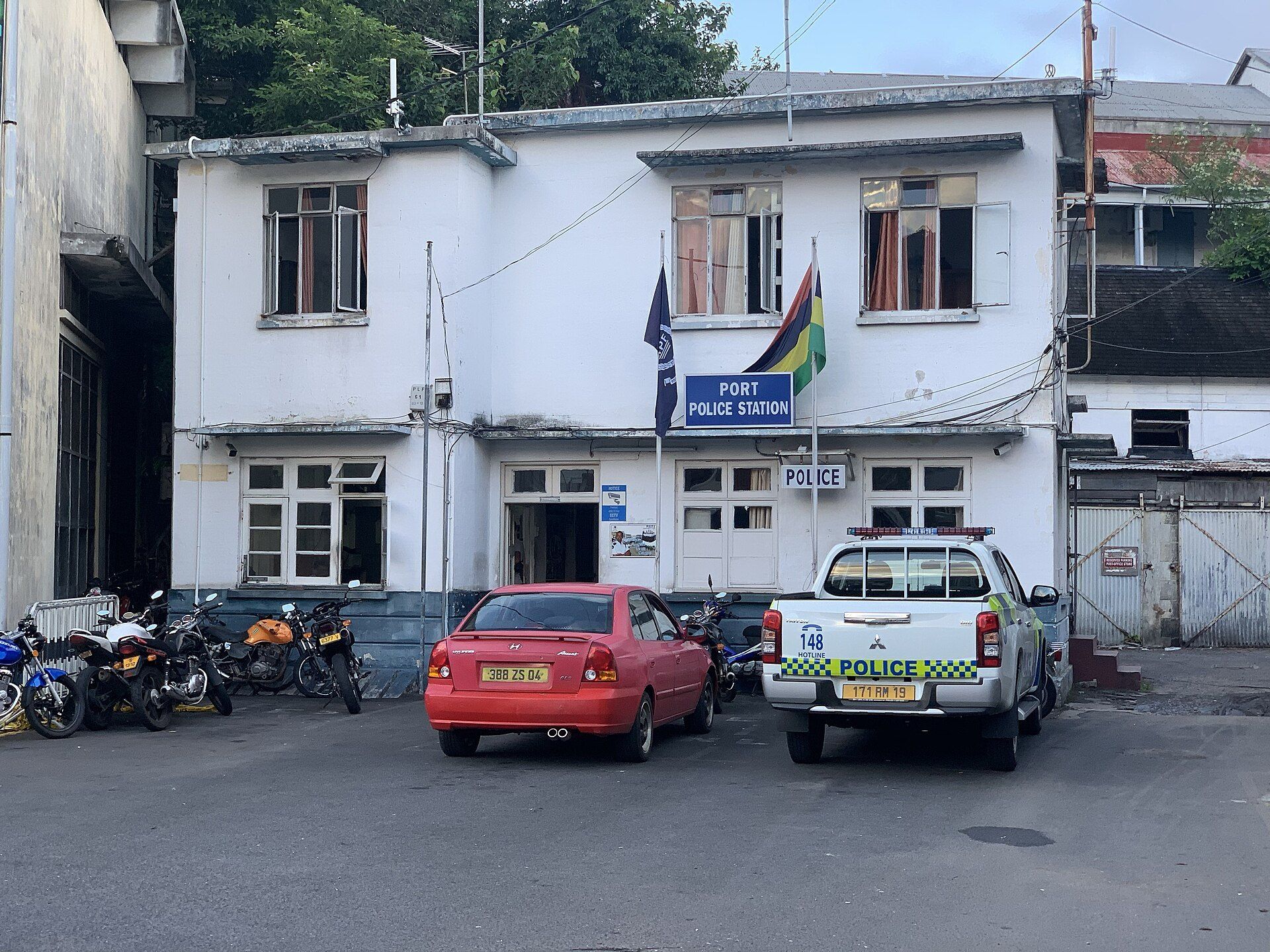
It was about 11:20 on the night of Friday, October 9, when the van carrying workers home from the late shift reached Camp-Levieux, a crowded neighbourhood about 15 kilometres south of Port Louis. Élodie Thomas, 27, a part-time cashier at a supermarket in Tribeca, sat on the second-to-last bench. She and a 22-year-old colleague had bought food and were sharing it, L’Express reported. Near the Ratsitatane crossroads, police stood where debris blocked the road. The driver, Tirvassen Soobrayen, says an officer warned him of the risk to his van. He says that while he looked for another route, the sergeant opened his door and pointed a weapon at his head, L’Express reported. He drove off. Perhaps 50 to 100 metres later, he says, a shot passed through the rear window. The colleague thought a stone had hit the van. Then Ms Thomas’s head slumped onto his shoulder, and by the light of his phone he saw blood on her face and neck. The bullet had struck her in the neck and jaw.
Sergeant Gautam Singh Taukoor, 57, is provisionally charged with using a firearm to intimidate the driver and with wounding Ms Thomas by imprudence, which means carelessness rather than intent, L’Express reported. He has not been tried, and the account above is the driver’s and the colleague’s. Police have not said what led to the shot.
On Saturday, October 24, two weeks later, according to Défi Média, the Independent Police Complaints Commission put out a public appeal for witnesses, L’Express reported. It asked for CCTV, photographs, video, dashcam and phone recordings of the shooting on Avenue Ratsitatane, to be sent to its office in the Emmanuel Anquetil Building in Port Louis, and set no deadline.
That appeal is where the real test begins. The state moved fast on the sergeant and moved fast on the riots. What the public will judge is the inquiry, and its first public step was a request for footage two weeks after a woman was shot in the neck. The curfew, the arrests and the talk of prosecuting children took the attention, while the shooting itself is what will decide whether Mauritians believe the state.
A week of anger and a curfew
The anger did not begin with the shooting; the Associated Press says the protests began the week before. On October 8 the government said reservoirs held 57.1 percent of capacity, down from 87.4 percent a year earlier. Statistics Mauritius put September inflation at 4.1 percent, up from 3.4 percent a year before. Prime Minister Navin Ramgoolam announced a night curfew on Tuesday, October 13, and after a special Cabinet meeting the hours became 8:30 pm to the early morning on Wednesday and Thursday. On October 16 the Prime Minister’s office extended it for three more nights, with hours of 10 pm to 4:30 am. The curfew ended at 4:30 am on Monday, October 19, Al Jazeera reported, and the Prime Minister said Ms Thomas’s condition was stable.
Reuters says she was travelling home from work in a van, and that the Health Ministry said she had surgery to remove the bullet and that it went well. She took her first steps with a walker on October 15, L’Express reported. Al Jazeera and TRT Afrika put arrests at at least 188, and the Police Force gave the same number in its reply to The Field. Al Jazeera says the charges included looting, arson, damage to police stations and possession of explosives. Citing a police report given to the Cabinet, the Associated Press said 94 people were arrested up to the Tuesday, among them 16 minors and one police officer, and that those arrested could be charged under the Prevention of Terrorism Act, the country’s terrorism law, where it applies. Twelve people charged with breaking the curfew pleaded guilty on October 16, and their sentencing date has been reported as October 19 and later as October 27, L’Express and Défi Média say.
Two kinds of response
The government has made two kinds of response. Charging the sergeant answers the shooting. The curfew, the arrests and the proposed change to the Children’s Act answer the riots. Both are legitimate, but the second takes far more space, and it brings children and a terrorism law into the public conversation. The Cabinet examined lowering the age of criminal responsibility from 14 to 12 but chose wider consultations and a parliamentary committee, Défi Média reports, and L’Express says no definitive decision has been taken. The Prime Minister has filed a motion for a Select Committee on juvenile delinquency, a group of members of Parliament that can call witnesses and ask for documents, Défi Média reported. Défi Média is the only outlet I found reporting the notice of motion itself, filed on October 21, though L’Express also reports the committee.
On Tuesday, October 20, the member of Parliament Adrien Duval asked in the National Assembly why the sergeant is not charged with attempted murder. Ramgoolam said that is for the Director of Public Prosecutions, the state’s chief prosecutor, to decide, L’Express reported. A second L’Express report adds that he said the sergeant’s alcohol and drug tests were negative, and that Duval objected that the drug test was done more than 20 hours after the incident. Four officers are suspended. L’Express reported on October 12 that intent is the central question, which the ballistic evidence and testimony will have to clarify, L’Express reported, and that the possible charge depends on the shot, ranging from wounding by imprudence to attempted manslaughter. The sergeant appeared again at the Rose-Hill court on October 26, police opposed his release, and he was held until October 30, Défi Média reported. I found no new charge. The two provisional charges are using a firearm to intimidate and involuntary wounds and blows by imprudence, and an earlier charge of possessing a firearm with intent to endanger life was dropped after consultation with the prosecutor’s office, according to L’Express. Three other officers involved in the Camp-Levieux operation were provisionally charged with failing to help Ms Thomas and released on bail, Le Mauricien reported.
What other countries show
Mauritius has been here before. In 1999 the death in police custody of the singer Kaya led to days of rioting, and Amnesty International’s report for 1999 says the official inquiry was still unfinished at the end of the year, after a family-commissioned autopsy showed signs of beating that contradicted the police account. That history makes the inquiry the main test, though I have no survey of how Mauritians judged the response in 1999.
Elsewhere the force came quickly and the accountability slowly or not at all. In Kenya, Al Jazeera reported in June 2026 that tallies put the number killed in the 2024 protests at about 62, and that only three of those deaths had reached court two years later. In Mozambique, about 400 people were killed in the unrest after the October 2024 election, Human Rights Watch says; by July 2025 the Attorney General had announced 31 criminal proceedings against police, but the hearing had not yet produced formal charges. In Madagascar, protests that began in September 2025 over electricity and water outages grew into anger at the whole government. The president fled and an army colonel took power; a year on, an anniversary report finds little change.
Mauritius starts from a stronger position than any of the three. Its sergeant was charged within days, and its police-complaints law already gives an independent body real powers. As I read the Commission’s Act, section 4(b) gives the Independent Police Complaints Commission the duty to investigate deaths in custody and deaths resulting from police action, while other cases depend on a complaint. Ms Thomas survived, and complaints were filed in her name and by the van driver, and the Commission opened two investigations on October 12, Défi Média reports. Le Mauricien reported that the Commission questioned the sergeant for about five hours on October 21, with his lawyer present, and that investigators await a ballistic report. Défi Média says the Commission expects to finish by the end of November, after which the file goes to the prosecutor. I am not a Mauritian lawyer and could be wrong about how the Commission applies its duty in practice, which is a reason for it to say so publicly.
The children and the arrests
The proposal to lower the age of prosecution from 14 to 12 is the part most likely to outlast the curfew. The United Nations Committee on the Rights of the Child encourages countries to set the age at no lower than 14, according to a summary of paragraph 33 of its guidance, so a move to 12 would take Mauritius below that minimum. Sixteen of the 94 people arrested through Tuesday were minors, which shows that children are in the streets and says nothing about whether younger children can fairly be prosecuted. A law made in a week of unrest is hard to undo.
The arrests are the other part the public cannot yet check. The arrest figures came from a police report given to the Cabinet and from outlets that name no source for them. The Force has not said how many of the 188 are minors or under which charges they were held, and I found no report that anyone has been charged under the Prevention of Terrorism Act.
Could it have gone differently?
Yes. The appeal for footage could have gone out in the first days, when phones and cameras still held the recordings. By October 24 the video that exists may have been shared widely, or lost. A date for the Commission’s report could be published now. And the debate on prosecuting children could have waited for a committee before it entered the Cabinet room in a week of riots. The state did the quick thing well, and the slow thing is the one still open.
The evidence that Mauritius did better will be plain when it comes: a Commission report with a date, a final charge in court that matches the evidence, a published count of arrests by charge, and an age of prosecution that stays at 14 or, if the new committee proposes a change, a published evidence base for it.
Comments
Every comment is read by a person before it appears, so yours will not show straight away. We publish comments that are civil and on the subject. To report a mistake in the piece, use the corrections page, so it is fixed in the piece itself.